— Community / June 8, 2026

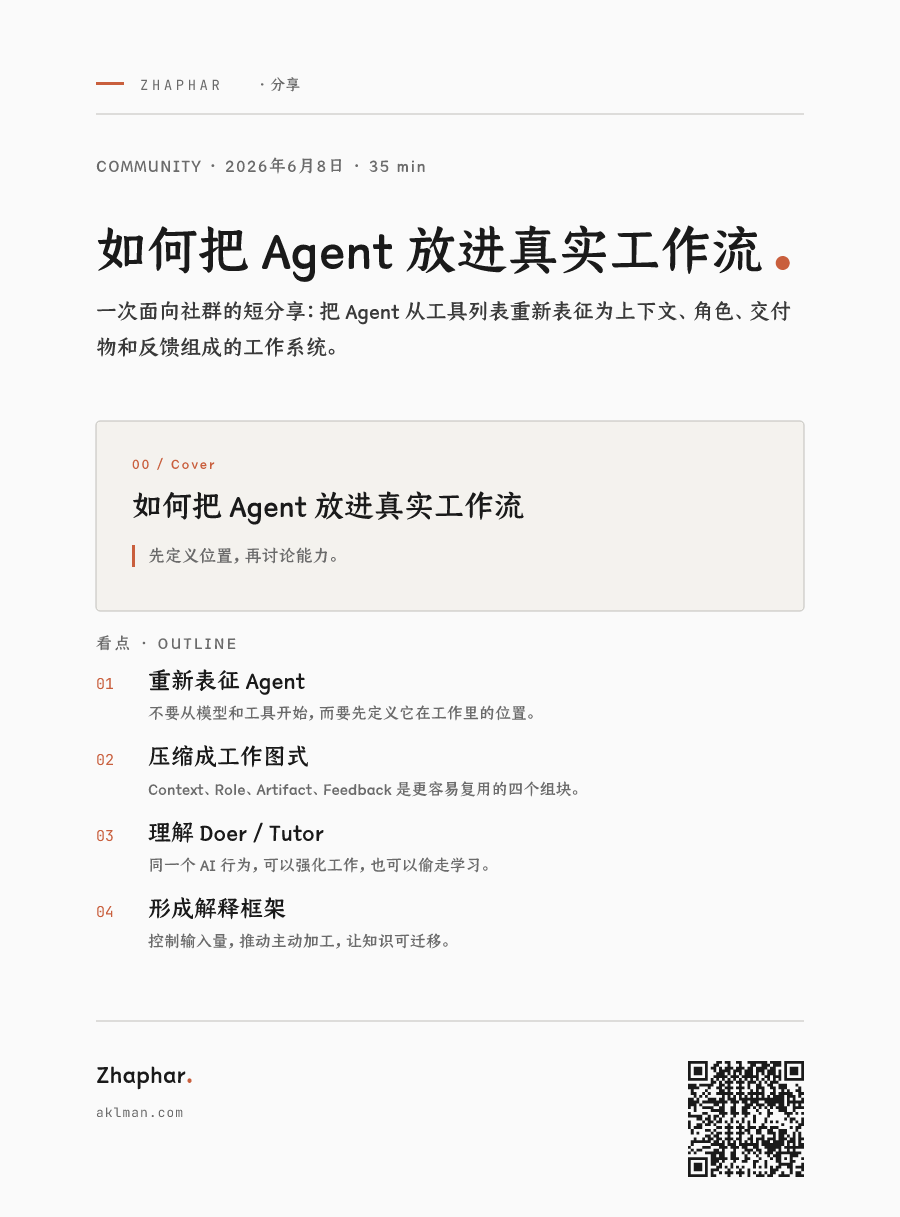
Putting Agents Into Real Workflows

A community session on reframing agents from tool lists into work systems made of context, roles, artifacts, and feedback.

CommunityWeChat Group35 minAI Agents · Workflow Design · Human Agent Collaboration
Open slides Print

— Outline

Outline

  1. 01

    Reframe the agent

    Start from the agent's position in the work, not from models or tools.

  2. 02

    Compress work into a schema

    Context, Role, Artifact, and Feedback are the four reusable chunks.

  3. 03

    Understand Doer and Tutor

    The same AI behavior can strengthen the work or steal the learning.

  4. 04

    Build an explanation frame

    CLT controls input, ICAP deepens processing, and mental models decide transfer.

— Notes

Notes

The session moves people from choosing tools to designing repeatable work systems.

The useful unit is not a prompt. It is a loop: context enters, a role acts, an artifact is produced, and feedback becomes the next run.

The long-term value is an inner map: a way to recognize the next situation faster and judge the path with less noise.

— Slides

Slides

  1. 01

    01 / Reframe

    An agent is not a tool list

    A better representation is this: an agent is a work unit placed inside context, roles, artifacts, and feedback loops.

  2. 02

    02 / Resources

    Three primary objects

    A real workflow is not a chat trace. It is a set of objects that can be identified, assigned, checked, and reused.

  3. 03

    03 / Flow

    How one collaboration flows

    Work is not a single exchange but a loop you can run again: goals go in, judgment comes back.

  4. 04

    04 / Doer vs Tutor

    The Doer / Tutor boundary

    The same agent behavior can help you form a mental model, or let you bypass one.

— Discussion

Manage on GitHub

Comments

Join the conversation through GitHub Discussions. Replies follow your GitHub notification settings.

Comments are powered by GitHub Discussions. Please keep the conversation focused and respectful.

← Back to sessions